
Interest Calculator
Calculate simple and compound interest with real-time visualizations. Plan your financial future with precision.
Calculator
Adjust values to see real-time results
Growth Over Time
Total amount accumulated year by year
Year-by-Year Breakdown
| Year | Total Amount | Interest Earned |
|---|
Introduction
In today’s financial landscape, understanding how your money grows is more important than ever. Whether you’re saving for retirement, investing in bonds, or earning interest on a savings account, knowing the exact numbers can make a significant difference in your financial planning. An interest calculator is a powerful tool that helps you visualize and understand exactly how much money you’ll earn (or owe) over time. Instead of manually calculating complex formulas, you can input a few simple numbers and get instant results. In this comprehensive guide, we’ll explore everything you need to know about interest calculators, how they work, and how to use them to make better financial decisions.
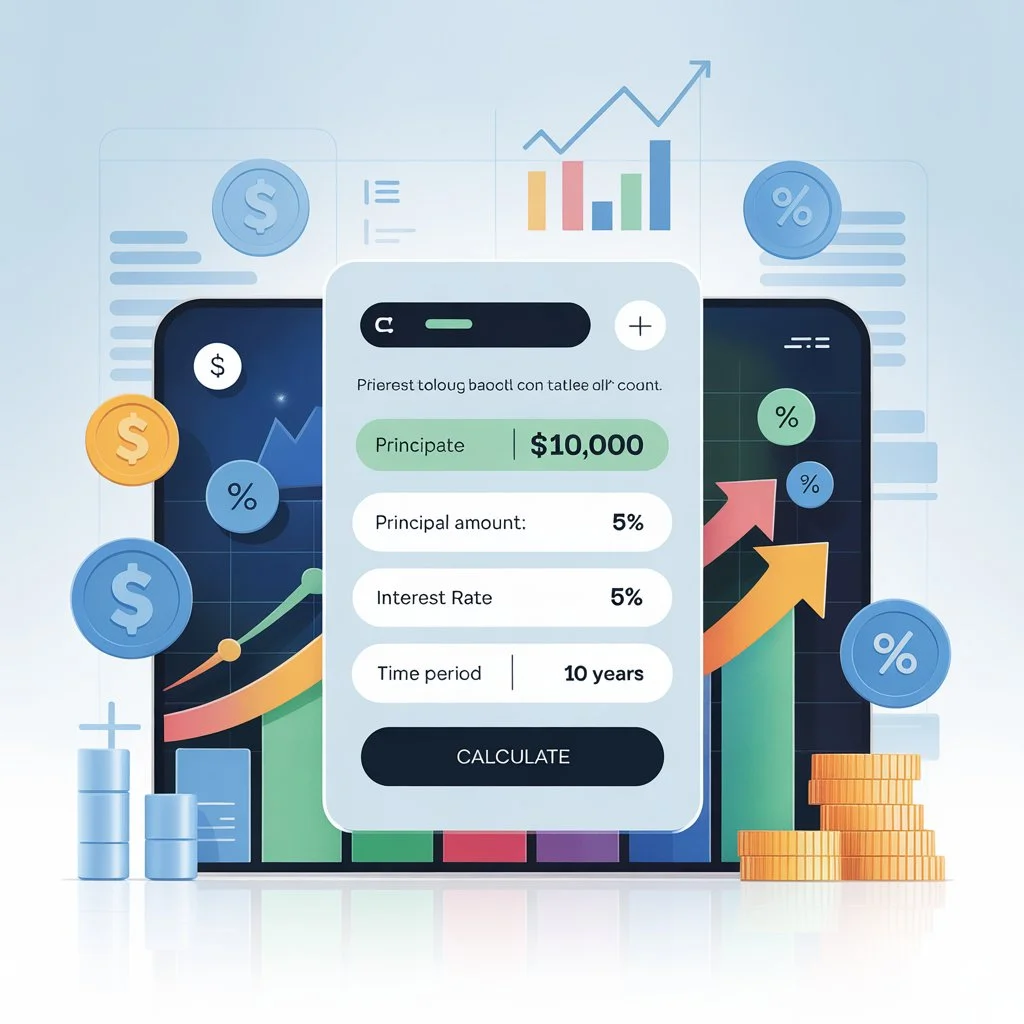
What is an Interest Calculator?
Definition
An interest kalkulator is a digital tool that computes the amount of interest earned or owed on a principal amount over a specified period. It uses mathematical formulas to calculate both simple interest and compound interest, providing accurate financial projections.
Why You Need an Interest Calculator
Who Should Use an Interest Calculator?
Simple Interest vs. Compound Interest: Understanding the Difference
One of the most important concepts in personal finance is understanding the difference between simple and compound interest. This distinction can mean thousands of dollars in your financial future.
What is Simple Interest?
Simple interest is interest calculated only on the principal amount, not on accumulated interest. It’s the most straightforward type of interest calculation.
Simple Interest Formula:
A = P(1 + rt)
Where:
Example:If you invest $10,000 at 5% simple interest for 5 years:
Key Characteristics:
What is Compound Interest?
Compound interest is interest calculated on both the principal and the accumulated interest from previous periods. This is often called “interest on interest” and is the most powerful force in wealth building.
Compound Interest Formula:
Plain Text
A = P(1 + r/n)^(nt)
Where:
Example:If you invest $10,000 at 5% compound interest (compounded monthly) for 5 years:
Key Characteristics:
The Power of Compound Interest
Notice the difference:
That’s an extra $333.59 from compound interest alone! Over longer periods and with higher rates, this difference becomes dramatically larger. Albert Einstein allegedly called compound interest “the eighth wonder of the world.” Those who understand it earn it; those who don’t pay it.
How to Use an Interest Calculator: Step-by-Step Guide
Using an interest calculator is simple, but understanding what each input means is crucial for accurate results.
Step 1: Enter Your Principal Amount
The principal is the initial amount of money you’re investing or borrowing.
Tips:
Example: If you’re starting with $10,000, enter 10000
Step 2: Enter the Annual Interest Rate
The annual interest rate is the percentage of your principal that you’ll earn (or pay) each year.
Tips:
Step 3: Set Your Time Period
The time period is how long you want to calculate interest for, typically measured in years.
Tips:
Example: If you’re planning for 5 years, enter 5
Step 4: Choose Your Calculation Type
Decide whether you want to calculate simple or compound interest.
When to use Simple Interest:
Step 5: Select Compounding Frequency (For Compound Interest)
If you chose compound interest, select how often interest is compounded:
Common Compounding Frequencies:
| Frequency | Compounds | Times Per Year | Best For |
| Annually | Once per year | 1 | Bonds, some investments |
| Semi-Annually | Twice per year | 2 | Some bonds |
| Quarterly | Four times per year | 4 | Some savings accounts |
| Monthly | Twelve times per year | 12 | Most savings accounts |
| Daily | 365 times per year | 365 | High-yield savings accounts |
Important: More frequent compounding = more interest earned. Daily compounding typically yields the highest returns.
Step 6: Review Your Results
The calculator will display:
Real-World Examples: See the Calculator in Action
Let’s explore practical scenarios where an interest calculator becomes invaluable.
Example 1: Saving for a Down Payment
Scenario: You want to save $50,000 for a home down payment in 5 years. Your high-yield savings account offers 4.5% APY, compounded daily.
Calculator Input:
•Principal: $50,000
•Interest Rate: 4.5%
•Time Period: 5 years
•Calculation Type: Compound
•Compounding Frequency: Daily
Results:
•Total Amount: $62,363.01
•Interest Earned: $12,363.01
•Gain: 24.7%
Insight: Your money grows by nearly $12,400 just from interest! This shows why starting early matters.
Example 2: Understanding Credit Card Debt
Scenario: You have a $5,000 credit card balance at 18% APR (typical for credit cards). You make no payments.
Calculator Input:
•Principal: $5,000
•Interest Rate: 18%
•Time Period: 1 year
•Calculation Type: Compound
•Compounding Frequency: Monthly (typical for credit cards)
Results:
•Total Amount: $5,984.74
•Interest Owed: $984.74
•Gain: 19.7%
Insight: Without payments, your debt grows by nearly $1,000 in just one year! This demonstrates why paying off high-interest debt quickly is critical.
Example 3: Long-Term Investment Growth
Scenario: You invest $10,000 in a diversified portfolio with an average 7% annual return, compounded annually, for 30 years (typical retirement timeline).
Calculator Input:
•Principal: $10,000
•Interest Rate: 7%
•Time Period: 30 years
•Calculation Type: Compound
•Compounding Frequency: Annually
Results:
•Total Amount: $76,122.55
•Interest Earned: $66,122.55
•Gain: 661%
Insight: Your initial $10,000 grows to over $76,000! This is the power of long-term compound interest and why starting early with investments is crucial.
Example 4: Comparing Simple vs. Compound Interest
Scenario: $20,000 loan at 6% interest for 10 years
Simple Interest:
•Total Amount: $32,000
•Interest Paid: $12,000
Compound Interest (Monthly):
•Total Amount: $36,140.18
•Interest Paid: $16,140.18
Insight: Compound interest costs you an extra $4,140 on this loan! Always understand how your interest is calculated.
Advanced Features & Calculations
Modern interest calculators offer sophisticated features beyond basic calculations.
Real-Time Visualization Charts
What They Show:
•Visual representation of your money growing over time
•Easy identification of growth acceleration
•Comparison between different scenarios
Why They Matter:
•Seeing growth visually is more motivating than numbers alone
•Charts help identify when compound interest really kicks in
•Useful for presentations and explaining to others
Year-by-Year Breakdown Tables
What They Include:
•Annual total amount
•Interest earned each year
•Cumulative growth
Why They Matter:
•Detailed tracking of progress
•Identify which years have the most growth
•Useful for tax planning and reporting
Multiple Scenario Comparison
What You Can Do:
•Compare different interest rates
•Test various time periods
•Evaluate different compounding frequencies
•See how small changes impact results
Why It Matters:
•Find the best savings account or investment
•Understand the cost of different loans
•Make data-driven financial decisions
Adjustable Parameters
What You Can Modify:
•Principal amount
•Interest rate
•Time period
•Compounding frequency
•Calculation type
Why Flexibility Matters:
•Test “what-if” scenarios
•Understand sensitivity to different variables
•Make better financial plans
Common Mistakes to Avoid When Using an Interest Calculator
Mistake 1: Confusing APR with APY
The Problem:
•APR (Annual Percentage Rate) = stated interest rate
•APY (Annual Percentage Yield) = actual return including compounding
APY is always higher than APR when compounding occurs.
Solution: Use APY for savings accounts and investments; use APR for loans.
Mistake 2: Forgetting About Inflation
The Problem:A 2% interest rate might sound good, but if inflation is 3%, you’re actually losing purchasing power.
Solution: Consider real returns (interest rate minus inflation rate) when planning long-term investments.
Mistake 3: Ignoring Fees
The Problem:Many savings accounts and investments charge fees that reduce your actual returns.
Solution: Subtract fees from your interest rate to get a realistic picture.
Mistake 4: Using the Wrong Compounding Frequency
The Problem:Using annual compounding for a daily-compounding account will underestimate your returns.
Solution: Always check your account documents for the actual compounding frequency.
Mistake 5: Assuming Constant Interest Rates
The Problem:Interest rates change over time. Your calculator shows projections based on current rates.
Solution: Treat projections as estimates, not guarantees. Review regularly and adjust as rates change.
Mistake 6: Not Accounting for Withdrawals or Additional Deposits
The Problem:Most calculators assume a static principal. Real savings accounts have deposits and withdrawals.
Solution: Use the calculator as a baseline, then adjust for expected changes.
Mistake 7: Comparing Different Compounding Frequencies Incorrectly
The Problem:A 5% rate compounded daily is better than 5% compounded annually, but the difference is often misunderstood.
Solution: Always compare using APY (which accounts for compounding) rather than APR.
Frequently Asked Questions About Interest Calculators
Q1: What’s the difference between an interest calculator and a compound interest calculator?
A: An interest calculator can compute both simple and compound interest. A compound interest calculator specifically focuses on compound interest calculations. Most modern calculators handle both types.
Q2: Can I use an interest calculator for loans?
A: Yes! Interest calculators work for both savings/investments (where you earn interest) and loans (where you pay interest). The calculations are the same; only the perspective changes.
Q3: How accurate are interest calculator results?
A: Interest calculators are highly accurate for the inputs provided. However, they assume constant interest rates and no additional deposits or withdrawals. Real-world results may vary slightly due to these factors.
Q4: What’s the best interest rate I can get?
A: Interest rates vary by:
•Institution (banks, credit unions, online banks)
•Account type (savings, money market, CD)
•Current economic conditions
•Your creditworthiness (for loans)
As of 2026, high-yield savings accounts typically offer 4-5% APY. Always compare rates before opening an account.
Q5: How does compound interest help me build wealth?
A: Compound interest accelerates wealth building by:
1.Earning interest on your principal
2.Earning interest on that interest
3.Creating exponential growth over time
4.Requiring no additional effort from you
The longer your money compounds, the more dramatic the effect.
Q6: Can I use an interest calculator for retirement planning?
A: Yes, but it’s a simplified tool. For comprehensive retirement planning, consider:
•Retirement calculators (account for inflation, withdrawals)
•Professional financial advisors
•Retirement planning software
An interest calculator is great for understanding basic growth projections.
Q7: What if my interest rate changes?
A: If your rate changes, simply recalculate with the new rate. Most interest calculators allow you to adjust this parameter instantly. For variable-rate accounts, use your current rate as an estimate.
Q8: How often should I recalculate my projections?
A: Recalculate:
•When interest rates change
•When you reach a major milestone
•Annually as part of financial planning
•When considering a new savings account or investment
Q9: Is compound interest better than simple interest?
A: For savings and investments, yes—compound interest is always better. You earn more money. However, for loans, simple interest is better (you pay less). Always understand which type applies to your situation.
Q10: Can I use an interest calculator on my phone?
A: Yes! Many interest calculators are available as:
•Mobile apps
•Responsive web tools (work on any device)
•Progressive web apps (work offline)
Look for calculators that work on your device for convenience.
The Science Behind Interest Calculations
The Mathematics of Compound Interest
The compound interest formula is one of the most important equations in finance:
Plain Text
A = P(1 + r/n)^(nt)
Breaking it down:
•P(1 + r/n)^(nt) represents your money multiplying
•(1 + r/n) is your growth factor each compounding period
•^(nt) means you apply this growth factor many times
•The more times it compounds, the larger your final amount
Why Compounding Creates Exponential Growth
Imagine $1,000 at 10% annual interest:
| Year | Simple Interest | Compound Interest |
| 1 | $1,100 | $1,100 |
| 5 | $1,500 | $1,610.51 |
| 10 | $2,000 | $2,593.74 |
| 20 | $3,000 | $6,727.50 |
| 30 | $4,000 | $17,449.40 |
Notice how compound interest pulls away dramatically over time? That’s exponential growth in action.
The Rule of 72
A quick way to estimate how long it takes to double your money:
Plain Text
Years to Double = 72 ÷ Interest Rate
Example: At 6% interest, your money doubles in 72 ÷ 6 = 12 years.
This rule of thumb works surprisingly well and helps you quickly evaluate investment opportunities.
Practical Applications: Where Interest Calculators Help Most
1. Savings Account Optimization
Use Case: Comparing different savings accounts to maximize interest earned
How It Helps:
•Compare APY across institutions
•See how different rates impact your savings
•Identify the best accounts for your goals
2. Investment Planning
Use Case: Projecting returns on stocks, bonds, or mutual funds
How It Helps:
•Estimate long-term investment growth
•Compare different investment options
•Plan for retirement or major purchases
3. Loan Evaluation
Use Case: Understanding the true cost of loans
How It Helps:
•Compare different loan offers
•See total interest paid over the loan term
•Understand the impact of paying extra principal
4. Debt Payoff Planning
Use Case: Calculating how long it takes to pay off debt
How It Helps:
•Understand compound interest working against you
•See the benefit of paying extra
•Stay motivated with clear goals
5. Financial Education
Use Case: Teaching students about compound interest
How It Helps:
•Visualize abstract financial concepts
•Demonstrate the power of starting early
•Make finance more engaging and understandable
6. Business Financial Planning
Use Case: Calculating returns on business investments
How It Helps:
•Project business loan costs
•Evaluate investment opportunities
•Plan for growth and expansion
Tips for Maximizing Your Interest Earnings
Tip 1: Start Early
The earlier you start saving or investing, the more time compound interest has to work. Starting at 25 instead of 35 can mean hundreds of thousands of dollars difference by retirement.
Tip 2: Choose Higher Compounding Frequency
Daily compounding beats monthly, which beats quarterly. While the difference might seem small initially, it compounds (pun intended) over time.
Tip 3: Seek Higher Interest Rates
Even a 1% difference in interest rate can mean thousands of dollars over decades. Shop around for the best rates.
Tip 4: Make Regular Deposits
While calculators assume a static principal, adding regular deposits dramatically accelerates growth. Every dollar you add starts earning interest immediately.
Tip 5: Avoid Withdrawals
Every withdrawal interrupts the compounding process. If possible, let your money grow undisturbed.
Tip 6: Reinvest Your Interest
If your account allows, reinvest interest earnings rather than withdrawing them. This maximizes compound interest.
Tip 7: Monitor and Adjust
Interest rates change. Review your accounts regularly and move money to higher-yielding options when available.
Conclusion: Take Control of Your Financial Future
An interest calculator is more than just a mathematical tool—it’s a window into your financial future. By understanding how interest works and using a calculator to project your scenarios, you gain the knowledge needed to make better financial decisions.
Key Takeaways:
1.Compound interest is powerful: It’s the force behind wealth building and debt accumulation.
2.Small differences matter: A 1% difference in interest rate compounds into thousands of dollars over time.
3.Time is your greatest asset: Starting early gives compound interest decades to work its magic.
4.Knowledge is power: Understanding your numbers helps you make confident financial decisions.
5.Use tools wisely: An interest calculator is a guide, not a guarantee. Real-world results depend on many factors.
Whether you’re saving for retirement, evaluating a loan, or teaching someone about finance, an interest calculator is an invaluable tool. Use it to explore different scenarios, understand your options, and make decisions that align with your financial goals. Start using an interest calculator today and take the first step toward financial clarity and growth. Your future self will thank you.